How To Position Your Brand as a Pioneer
What do the visionaries of this world have in common? And musings on how you can build tomorrow's brands today.

What do the visionaries of this world have in common? And musings on how you can build tomorrow's brands today, even if you see yourself as just a good person trying to do meaningful work in business.
A pioneer is defined as being “one of the first people to do something", quite literally one of the first people to act. A pioneering brand is much the same; they are on a mission to disrupt a stale industry, tell a new story or solve a new problem with innovative ideas and original approaches. Pioneering brands excite us, win over consumers, shape culture and craft the future.
Book a call
"Pioneer" position meaning & definition
To position your brand as a pioneer means claiming first-mover advantage—the competitive edge gained by being the first to introduce a new technology, product, or service to the market. This is the core of the pioneer position meaning in brand strategy.
This strategic positioning allows early pioneers to establish brand recognition, capture market share, and create systems that competitors must later navigate. Research shows that first movers like Uber command approximately 76% of market share in their sectors, while later entrants struggle to catch up.
The reality is clear: being first provides substantial benefits, from setting pricing strategies to building enduring customer loyalty and opening up new opportunities that followers must work harder to find.
What it really means to be a pioneer
To better understand what it means to be a pioneering brand, let's explore the characteristics that define pioneering people throughout history. From Thomas Edison's invention of the incandescent light bulb to Henry Ford's development of the assembly line, and from Coco Chanel's redefinition of fashion to Elon Musk's bold ventures into space exploration and sustainable energy, pioneers share common traits that entrepreneurs, founders and brand leaders can learn from.
Pioneers are typically free-thinking, adventurous, spontaneous, and highly creative. They are independent-minded, often clever, and always original. If a novel solution to a problem is needed, the pioneer is the right person to ask because they tend to use original approaches to solve difficult problems.
They give special attention to key issues and are future-oriented, constantly looking forward rather than dwelling on the past, which helps them lead their company, team or group into what’s next.
Pioneers are usually enterprising and prepared to take risks. They tend to have a lot of ideas and distinguish themselves through originality. The pioneer thrives on the development of strategies for the future, exploring how new technology, media and services can create value for customers and society. They are often described as individualistic and unorthodox, are typically introverted and self-willed, and are generally sensitive to both appreciation and criticism. Sound familiar?
Brands, like people, have inherent traits and values. If you want to be a pioneering brand, you are going to have to adopt some of the same values as pioneering people, typically free thinking, highly creative, and independent minded. This belief system forms the foundation of your brand's identity and guides how you act in the world and in your country’s wider business community.
Free thinking | Adventurous | Spontaneous | Highly creative | Independent-minded | Clever | Always original | Problem solvers | Future orientated | Risk-takers | Unorthodox | Ambitious | Experimental
You could think of this as your internal pioneer position meaning; what your brand stands for before any campaign, product, or piece of content goes out into the world.
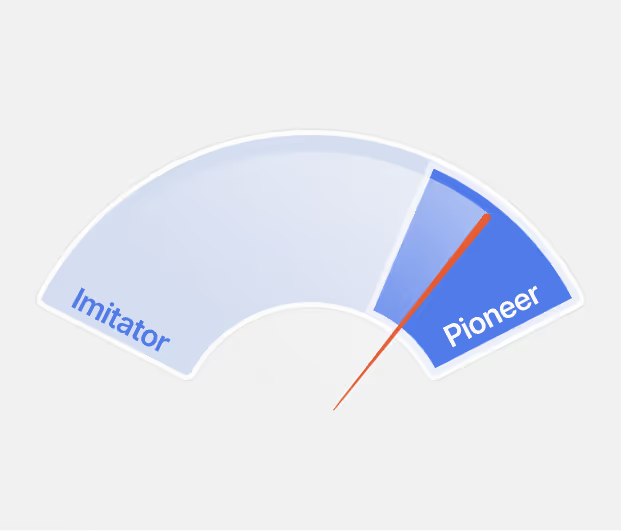
Pioneering brands vs follower brands
You now need a mission
Once you have defined your values as a brand, it's time to state your mission and vision.
"You don't have to be a fantastic hero to do certain things – to compete. You can be just an ordinary chap, sufficiently motivated to reach challenging goals." Sir Edmund Hilary.
Let's reframe this in the context of the brand world…
You don't have to be a fantastic brand to do certain things—to compete. You can just be an established company, sufficiently motivated to reach challenging goals and focused on creating genuine value for your consumers.
What separates a mediocre company and pioneering brand is the motivation to embody a challenging mission and vision. To be a pioneer, you need imagination and an appetite for risk to set a goal that you may not achieve, that will challenge the status quo and stretch your team beyond what they expected. The bigger the mission the bigger the reward.
F.B. Hawley states that profit is a reward for risk taken in business. How much of a creative risk are you willing to take, and what kind of innovation are you prepared to develop to achieve meaningful success?
Brands on a mission
What do all these brands have in common: Apple, Deliveroo, Uber, Airbnb, Tesla, Nasa, Impossible foods? You guessed it, they are all pioneers. They have all been the first to meet an unmet need, deliver an innovative new product or service, or tell an alternative story that changed how consumers think, act and buy.
As curious beings, we value pioneers and adventurers in high esteem. Their stories excite us and there’s something within us that aspires to be like them—whether as individuals, founders, or entrepreneurs building brands that lead their industry and their part of the world. They are an example of how a brand, when aligned with a clear mission, can act decisively and reshape its category.
So, how do you put all that into practice?
- Look for unsolved problems.
- Examine the industry you are in and identify gaps.
- Challenge convention and tradition.
- Ask why (a lot).
- Start with problems, not solutions.
- State your mission to the world through your brand story, your media presence and how your team behaves.
- Take risks (the bigger the better, within reason).
- Experiment often and learn from mistakes.
In doing so, you begin to develop your own pioneering brand playbook: how your company finds opportunities, creates solutions, and leads your customers and community forward.
How to position your brand as a pioneer: step-by-step
Look for unsolved problems
Every pioneering brand starts with curiosity. Instead of copying what’s already working, look for pain points that everyone accepts as “just the way things are.” That’s your opportunity to innovate and bring something new (and genuinely useful) into the world.
Examine the industry you are in and identify gaps
Take a good, honest look around your category. Where are customers underserved? Where are competitors asleep at the wheel? Spotting the blind spots in your industry is how you build ideas that others overlook.
Challenge convention and tradition
Pioneers aren’t afraid to ruffle a few feathers. If everyone’s heading left, ask what happens when you go right. By questioning the rules, you create space for fresh thinking. That’s where the best innovation lives.
Ask why (a lot)
Curiosity is your brand’s compass. Keep asking “why” until you uncover the real reason things work the way they do, or don’t. This deeper understanding is what guides smarter decisions and sharper creativity.
Start with problems, not solutions
Don’t fall in love with your own idea too early. Start by truly understanding the problem you’re trying to solve, from your users’ point of view. The best solutions come from empathy, not ego.
State your mission to the world through your brand story
Your mission isn’t just marketing; it’s your brand’s heartbeat. Make sure it shows up everywhere; from your website copy to team culture and client conversations. Consistency turns bold words into lived experience.
Take risks (the bigger the better, within reason)
There’s no pioneering without a bit of courage. The key is to take smart risks that stretch your team without breaking it. Think of it like climbing: the higher the goal, the more strategic each step needs to be.
Experiment often and learn from mistakes
Trial, error, repeat. That’s the pioneering rhythm. Every test, even the failures, teaches you something valuable about your audience, market, and message. The trick is to keep moving and refining as you go.
Adventure vs roadmap
Gone are the days of 2, 5 & 10-year linear roadmaps. It's time to take your brand on an adventure. Set a far reaching goal and start your brand's mission. It's unlikely to be a simple linear journey, but by putting one foot in front of the other and solving problems as they arise, you’ll discover new opportunities and learn about your brand along the way.
You may find that your pioneer likes uncertainty more than most, and that your team grows as they act on bold ideas, test them with real consumers, and iterate. Over time, this course of action can turn an ordinary company into a brand that is seen as one of the first to innovate in its space, both in your home country and across the wider world.
"With practice and focus, you can extend yourself far more than you ever believed possible." Edmund Hilary.
If you would like help positioning your brand or defining your mission, get in touch with us at info@overpass.studio - we’d love to join you on your adventure, help your team clarify its vision, and support you in acting like the pioneering founders and entrepreneurs you admire
Brand Pioneer FAQs
How do I know if my brand has a pioneering angle?
Start by asking whether your brand is solving a problem in a way no one else is, or telling a story that challenges your industry’s norms. If your work feels a bit uncomfortable or ambitious, that’s often a sign you’re on to something new. Pioneering doesn’t always mean inventing; sometimes, it’s about reframing what already exists with fresh insight.
Can an established company still position itself as a pioneer?
Absolutely. Pioneering isn’t only for startups. It’s a mindset, not a stage of business. Established brands can rediscover their pioneering edge by exploring new technologies, refreshing their mission, or rethinking how they serve their customers in today’s context.
What if my experiments or risks don’t work out?
That’s part of the adventure. The most innovative brands treat failure as data, not defeat. Each test brings you closer to what does work. The key is to learn quickly, adjust your approach, and keep experimenting with curiosity rather than fear.
Get in touch


![6 Best Webflow Agencies For B2B SaaS [With Reviews]](https://cdn.prod.website-files.com/63f4f8b3637ca34b3b597dcd/6972206f4a7f922c730f7b66_max-brown.avif)